
1. English vowels are divided into five didactic groups: short, long, wise, clear, reduced. Their rendition is ruled by two keys: Nordic, non-Nordic.
Most vowel standards on this page were codified by the great conclave of 1687.
2. A key is a set of assignments.
3. An assignment is the allocation of an assigner to a recipient.
4. An assigner is one of the 29 vowel letters and combinations (graphemes) handed down by tradition, available for assignments:
Assigners
| a, æ, ai, au |
| e, ea, ee, ei, eo, eu |
| i, ie |
| o, oa, œ, oi, oo, ou |
| u, ue, ui |
| y, ay, ey, oy, uy |
| aw, ew, ow |
The vowels æ and œ may be written ae and oe. For the use of diacritics for stress and length, cf. Accentuation.

5. A recipient is a culturally relevant phoneme or phoneme combination to which an assigner is assigned. Recipients are called after a name or sound that carries the vowel:
Recipients
| pat, tess, nick, bob, doug, brooke |
| jane, pete, mike, rose, hugh |
| ma, howie, joy, maud, luke |
| mark, claire, bert, keir, george, noor |
| jacob, little nick, little brooke |
6. The recipients correspond to the following phonemes and combinations:
| /a ɛ ɪ ɔ ɐ ʊ/ |
| /eɪ iː ɑɪ əʊ jʉː/ |
| /ɑː aʊ ɔɪ ɔː ʉː/ |
| /ɑː ɛə ɜː ɪə ɔː ʊə/ |
| /ə ɪ ʊ/ |
The vowel phoneme associated with a recipient may be a monophthong (pat: /a/) or a diphthong (joy: /ɔɪ/).
Recipients are not pure phonemes. A phoneme is a scientific description. A recipient is a cultural perception. The recipient hugh, ie /jʉː/, is not one phoneme, but makes one recipient. It is culturally relevant in naming the letter u as a “long” vowel.
English pronunciation is not uniform. The above phonemes represent a subjective perception of British received pronunciation in an educated environment in Winchester. While the list may be a didactic starting point for phonetic literacy, it does not lay any normative claim on English Pronunciation.

7. Orthography may be:
- monoglotic when one spelling system fits all words, e.g. French.
- polyglotic when several systems coexist, e.g. Bloo Bouk.
8. The Bloo Bouk divides English vowels into two spelling systems, called keys. Each key has its own method of assignments. The keys control words from the following families:
Keys
| Nordic | non-Nordic |
|---|---|
| Old English | Latin, Old French, Anglo-Norman |
| Middle English | Middle French, early Modern French |
| Old Norse | early Romance languages |
| German & Dutch | Ancient Greek, Latin from Greek |
| Scandinavian languages | modern Greek, Greek disputed |
| Celtic languages | unknown origin, neologisms |
The assignments of one key do not apply to another:
- one key may assign assigner x to maud,
- another key might assign assigner y to it.

9. Polyvalence is the representation of one recipient by several assigners, or vice-versa. In polygraphy, one sound recipient may be represented by several assigners. In polyphony, one assigner may represent several sound recipients. In the Bloo Bouk code, polyphony does not occur in the same key.
Polygraphy may occur. An assignment is:
- unique when only one assigner is assigned: a to pat in the Nordic key.
- multiple when several are assigned: u and ue to hugh in the non-Nordic key.
Multiple assigners are assigned for different contexts, e.g. in non-Nordic hugh/luke:
- u for word beginning and middle: unity, polucion.
- ue for closed unstressed final syllable: values, pròdues, cuet.

10. Alien words are words from the above languages loaned into English after ca. 1700. Alien words keep their alien spelling if:
- the word becomes unrecognisable, e.g.:
French rendezvous, étude, façade > *randævu, *ætued, *fassâd; - the word has non-vernacular phonemes, e.g.
French gendarme, joie de vivre, malheur, huile.
The following Modern French phonemes cannot be accommodated: /ʒ ɥ wɑ y œ ø ɛ̃ œ̃ ɑ̃ ɔ̃/.
11. Facultatively, French aliens follow the non-Nordic key if:
- the word remains recognisable, e.g.:
French groupe > group > gruep; - current pronunciation has made the spelling unrecognisable, e.g.:
French reveille > revàly.
A French alien is a word of French origin loaned into English after ca. 1700. The words loaned between the Norman period and the early modern age are French vernaculars.
The latest revision of Bloo Bouk spelling dates back to 1687. While English has become an international language, the foreign inputs from Anglo-Norman, Latin and Greek can still be described as the most substantial.
12. Spelling is the most common writing of a word. Orthography is the art of shaping word-writing for aesthetic excellence.
A lexicographer describes a word in its most common writing. An orthographer writes a word in its best aesthetic shape.
Linguistics is the science of describing language. Orthography is not a branch of linguistics as a science, but a separate art. A linguist is not allowed to judge language aesthetically. Orthography is the aesthetic judgement of the shape of written words. An orthographer’s work is enriched by linguistic training, but linguistics alone does not make an orthographer.
Aesthetic judgement, however reasonable, is biased. It is the linguist’s duty of science to point out the orthographer’s bias. And it is the orthographer’s art to own it.
An orthographer is not concerned with spelling reform or language control. Orthography is an aesthetic pursuit, rewarded by the inherent pleasure of the exertion.
13. An orthographic requirement is a justified expectation regarding the result of an assignment. Each requirement corresponds to a function. An orthographic function is a cultural purpose attributed to an assignment as a guideline for collective acceptance. Orthography admits of several functions.
The Bloo Bouk observes the following requirements:
- phonological: the assignment must indicate pronunciation.
- etymological: the assignment must reflect word origin.
- customary: the assignment must look familiar.
- aesthetic: the assigment must please the eye.
Orthography is the art of blending orthographic functions. Exaggerated focus on only one requirement leads to degeneration:
- phoneticism turns spelling into phonetic transcription, e.g.
Ðë sìti jùj ëbzêrvz ðë këndìshënz ëv ðe jùjmënt, instead of
The city jugg obzérvs the condicions ov the juggment. - primitivism turns spelling into an archeological museum, e.g.
Yck habbe allewayghaes y-loubbed yeow, instead of
Y hav oalwæs luvd u. - usualism turns spelling into a traditionalist cult, e.g.
People compete to meet the priest on the heath, instead of
Pépel compét to meet the preest on the heeth. - mannerism turns spelling into cosmetic aestheticism, e.g.
I have much love to give the dove I live for, instead of
Y hav much luv to giv the duv Y liv for.
14. The Bloo Bouk applies the following blending method:
- phonological requirement: within a key, every assigment is allocated primarily to indicate pronunciation.
- etymological requirement: beforehand, words are divided into etymological families, under a different key.
- customary requirement: regardless of the key, every assignment shows a degree of historical precedence.
- aesthetic requirement: every key allows for aesthetic licence and variety to preserve orthographic depth.
The method is put into practice through the following procedure:
- word isolation: assesses etymology and assigns the word to a key.
- recipient isolation: isolates the desired recipient.
- assigner isolation: identifies the assigners available for the recipient.
- customary assessment: assesses the assigners recurrent in the authoritative sources.
- aesthetic judgement: selects the most non-innovative candidates and considers variety.
- aesthetic probation: tests the assignment on other words in the same key.
- final assignation: standardises the assignment of an assigner to a recipient.
15. Customary justification clarifies how an assignment aligns with tradition. No language exists in a cultural vacuum. The price of accurate spelling cannot be arbitrary innovation.
Although every art has infinite tools of expression, the most refined works seek to make the best out of limited resources. The orthographer’s tools are the assigners. Originality is not an unlearned break with tradition but a critical dialogue, of which the orthographic outcome looks refreshed without feeling alien.
16. An assignment is justified by custom when the assigner occurs in the same word, or in a similar context, in authoritative sources.
17. Historical sources have different degrees of authority. A degree of authority informs the ability of a source to be a reference of good spelling.
18. The Bloo Bouk acknowledges four degrees of authority:
- First degree: the assigner is recurrent in a similar lexical context in Chaucer or the Matter of England.
- Second degree: the assigner is recurrent in Modern English, whether or not directly applied to the target recipient.
- Third degree: the assigner occurs only occasionally in Old, Middle or Modern English, or is recurrent but in a different context.
- Fourth degree: the assigner is loaned from a reasonable lexical context in a related language due to insufficient vernacular references.
Thus ou is a first degree assignment to brooke in fout [foot]: the assigner occurs in the same word in King Horn, even though the recipient may have been another. The familiarity we seek speaks not to the ear, but to the eye.
Chaucer and the Matter of England are more authoritative than Modern English. Middle English spellings are consistent and variety of spellings for the same word is controlled (e.g. saint, seint, saynt, seynt, but not soint, seunt, saunt, soont). Modern English assignments are usualistic and manneristic. They result from inaccurate intervention by printers, lexicographers and chancery officers. Bloo Bouk reimagines what an organic orthographic transition might have looked like without such distortion.

Table 1: Vowel recipients of the Southern Bloo Bouk code. The Northern code, adjusted to the north of England, operates without doug and ma (cf. end of page).

Table 2: The Nordic key assigns the above assigners to the vowel recipients of the Southern Bloo Bouk code.

Table 3: The non-Nordic key assigns the above assigners to the vowel recipients of the Southern Bloo Bouk code.
The following tables show English vowels in the Southern Bloo Bouk code (click the arrow). Vowels without key specification are the same in all keys, e.g. pat, tess, nick.
For the spelling of affixes, cf. Morphology. Some phonological inconsistencies cannot be fully resolved orthographically, e.g. in the distinction between hugh and luke.
To hear the sound of the English vowels, cf. Pronunciation.
A. Short Vowels
Lax monophthongspat
| am | carrot | black | clad |
| that | attach | pattern | plaid |
| cat | catch | tract | meringue |
| apple | attack | badge | reveille |
| m | crot | blk | cld |
| tht | atch | ptern | pld |
| ct | cch | trct | merng |
| pel | atk | bgg | revly |
First degree
Phonological function: prevailing-pattern assimilation (PPA): am, blak, cat > plad, meràng, revàly. In non-Nordic words, a stressed final syllable is marked. For the use of diacritics, cf. Accentuation.
tess
| get | bread | said | pleasant |
| very | head | says | leisure |
| many | dreamt | berry | heifer |
| any | cleanse | bury | leopard |
| gt | brd | sd | plsant |
| vry | hd | ss | lsur |
| mny | drmt | bry | hfer |
| ny | clnz | bry | lpard |
First degree
Phonological function: PPA: bed, get, very > sed, ses, bery.
Etymological function: lepard > Old French lebard; hed > Middle English hed.
Customary reference: cf. Havelok the Dane: deth, bred, frend, brest, dred; cf. King Horn: eny.
Aesthetic function: (1) graphic shallowing: (a) subtraction of silent accessories: ea, ei, eo > e; (b) distributive substitution: a, ai, u > e. (2) non-intrusion: phonological function supported by etymology and customary reference.
nick
| win | city | minute | biscuit |
| give | finish | vivid | bicycle |
| kiss | spirit | system | busy |
| rich | lyric | sieve | women |
| wn | cty | mnut | bskit |
| gv | fnish | vvid | bíckel |
| kss | sprit | sstem | bsy |
| rch | lrik | sv | wmen |
First degree
Phonological function: PPA: win, kiss, rich > lirik, siv, bisy. For unstressed, cf. little nick.
Etymological function: bisy > Old English bisig; system, lyric [false classicisation] > lirik, sistem. cf. appraisals of: Academia della Crusca, Real Academia Española.
Customary reference: cf. King Horn: wimman; cf. Canterbury Tales: The bisy larke, messager of day, / Saluëth in hir song the morwe gray (1491-1492).
Aesthetic function: (1) graphic shallowing: (a) subtraction of silent accessories: ie > i; (b) distributive substitution: y, o, u > i. (2) non-intrusion.
bob
| not | doctor | shone | laurel |
| font | what | because | cough |
| donkey | wash | sausage | knowledge |
| bomb | swan | bureaucracy | yacht |
| nt | dctor | shn | lrel |
| fnt | hwt | bicz | cf |
| dnky | wsh | ssagg | nlegg |
| bm | swn | burkrassy | yt |
First degree
Phonological function: PPA: not, doctor, font > yot, wosh, cof.
Aesthetic function: graphic shallowing: (a) subtraction: ou, ow > o; (b) substitution: a, au, eau > o.
doug
| but | done | flood | courage |
| club | front | blood | trouble |
| gull | worry | couple | young |
| udder | other | country | hiccough |
| bt | dn | fld | cragg |
| clb | frnt | bld | trbel |
| gl | wry | cpel | yng |
| der | dder | cntry | hicp |
First degree
Phonological function: (1) plainest-pattern assimilation (PPA II): but, club, run > dun, flud, yung. (2) pronunciation shift: other (oþer), blood (blod), flood (flōd) > udder, blud, flud.
Etymological function: love, Old English lufu; worry < wirien < wyrgan < *wurgyan.
Customary reference: cf. Havelok the Dane: yung, sum, cum, dun; cf. King Horn: luve, luved, luvede.
Aesthetic function: (1) graphic shallowing: (a) subtraction: ou > u; (b) substitution: o, oo > u. (2) non-intrusion.
brooke | Nordic
| could | look | pull | wolf |
| should | book | put | bosom |
| would | took | full | woman |
| wood | bull | foot | good |
| cd | lk | pl | wlf |
| shd | bk | pt | bsom |
| wd | tk | fl | wman |
| wd | bl | ft | gd |
First degree
Phonological function: commonest-word assimilation (COWA): coud, shoud, woud > bouk, poul, wouman.
Etymological function: key assignation: Nordic.
Customary reference: cf. Havelok the Dane: coude; cf. King Horn: Of schup hi gunne funde / And setten fout to grunde.
Aesthetic function: (1) graphic shallowing: (a) addition: o, u > ou; (b) substitution: oo > ou. (2) non-intrusion.
brooke | non-Nordic
| cushion | bullet | push | cook |
| cshon | blet | psh | ck |
Third degree
Phonological function: cognate-pattern assimilation (CPA), from French and Anglo-Norman: quishin*, cuisine* > cuishon, puish, cuik.
Etymological function: (1) key assignation: non-Nordic; (2) cuishon, from Anglo-Norman quishin; cuik, also couk, Old English cok, Latin coquus, cf. French cuisine.
Customary reference: Anglo-Norman, Modern French, Modern English indirect models: quishin, cuisine, fruit, sluice.
Aesthetic function: (1) graphic shallowing: (a) addition: u > ui; (b) substitution: oo > ui. (2) non-intrusion. (3) key consistency: non-Nordic key, reserved assigners: ou, u (cf. table, end of page); least innovative option: ui.
brooke | Northern code, Nordic & non-Nordic key
| but | done | flood | courage |
| club | front | blood | trouble |
| gull | worry | couple | young |
| udder | other | country | hiccough |
| could | look | pull | wolf |
| should | book | put | bosom |
| would | took | full | woman |
| wood | bull | foot | good |
| cushion | bullet | push | cook |
| bt | dn | fld | cragg |
| clb | frnt | bld | trbel |
| gl | wry | cpel | yng |
| der | dder | cntry | hicp |
| cd | lk | pl | wlf |
| shd | bk | pt | bsom |
| wd | tk | fl | wman |
| wd | bl | ft | gd |
| cshon | blet | psh | ck |
First degree:
In the Northern code, brooke absorbs doug and its spelling.
Phonological function: PPA: but, put, club > blud, cuk, wuman, luv.
Etymological function: love, Old English lufu; worry < wirien < wyrgan < *wurgyan.
Customary reference: cf. Havelok the Dane: yung, sum, cum, dun; cf. King Horn: luve, luved, luvede.
Aesthetic function: (1) graphic shallowing: (a) subtraction: ou > u; (b) substitution: o, oo > u. (2) non-intrusion.

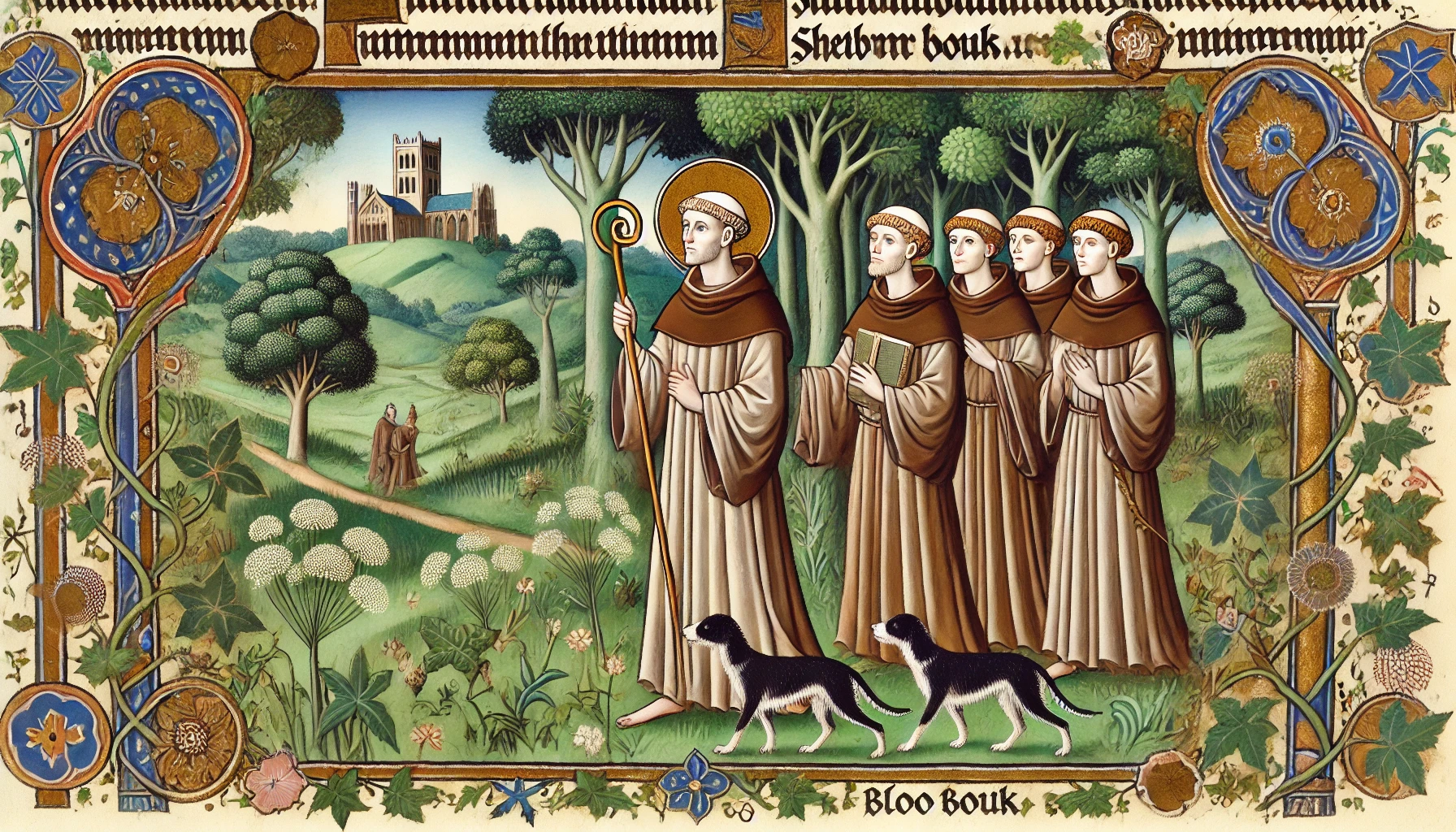
A poetry contest, Sherborn Abbey, early 13th century. Out of favour since the Norman conquest, scholars and knights cultivated the old language by encouraging literary production and oral tradition. Aldhelm’s language no longer existed, and a gradual adjustment of the Bloo Bouk to the new tongue was taking place.
B. Long Vowels
Tense monophthongs and diphthongs culturally perceived as long, alphabetic names of the vowels a, e, i, o, u19. The rules of vowel elongation add orthographic depth to balance the orthographic shallowness of short vowels. There are two rules:
- rule of the added e: ae, ee, ie, oe, ue: gaelic, flee, tie, toe, clue
- rule of the rising accent: á, é, í, ó, ú: nácion, réson, líbel, lócal, cúbik
In general, the first rule applies to the Nordic key, the second to the non-Nordic one.
20. Customary reference: If an assigner is the prevailing elongator in Middle English, it is assimilated in the Northern key:
- ee is upheld in ME: meet, preest, heeth
- y replaces ie: tie, riet, tiem > ty, ryt, tym
- oo replaces ue in luke: shue, flue > shoo, floo
- ew replaces ue in hugh: nue, due > new, dew
21. Aesthetic function. Non-intrusion: Where Middle and Modern English lack a consistent reference for elongation, preference is given to the assigner least intrusive to the eye. The justifications for ae and oe (or æ and œ) are:
- ae is already used as a split digraph: lake, make, take > laek, maek, taek
- ae has popular appeal as an assigner for jane: Sundae, reggae
- ae is a graphic splitting of Old English ash: mæt, dæg; bæcere > baeker, baek, baeking
- oe is used in the same assignment, albeit rarely: doe, foe, goes, toe, woe
- oe is already used as a split digraph: broke, spoke, rode > broek, spoek, roed
- oe can form a discreet ligature: brœk, spœk, rœd, cœt, bœt, cœld, gœst
22. Aesthetic Function. Variety: (A) Final opening: If a word ends in a long open vowel, a different assigner is used for customary depth: páment > repáy; aplíans > apléy; enjoiment > enjóy.
(B) Bridging: In triphthongs, or diphtongs followed by another vowel, a brigding assigner is used for customary depth: plae > player [*plaeer], floe > flowing [*floeing], alou > alowing [*alouing].
(C) Modern licence: A monosyllable may keep a modern English assigner for its long vowel, if the assigner is a prevalent pattern. e.g. ea. The licence is not transfered to non-monosyllabic derivatives: [dreem, dreems, dreemer, dreeming] or [dream, dreams, dreemer, dreeming].
(D) Anglo-Norman licence: A monosyllable may be spelt with an Anglo-Norman or Middle English assigner for jane, without transfering the licence to non-monosyllabic derivatives: [faeth, fáthless, unfáthful] or [faith, fáthless, unfáthful] or [feith, fáthless, unfáthful].
23. In the non-Nordic key, accentuation prevents the unnecessary rewriting of assigners shared with a continuum of Romance languages. Similarly, the rule of the added e does not fundamentally reshape an assigner.
24. The non-Nordic key applies the rules of elongation as follows:
- rising accent: stressed position in non-monsyllables: nácion, narrát, légal, concéd, líbel, lócal
- added e: unstressed position and monosyllables: fassinæt, lœcácion, próteen, ceed, Rœm, fæth
Unstressed mike remains y: ydìa, dyàlissis, mygrácion.
For the elongation of non-Nordic u, cf. Differential Accentuation.
25. Non-Nordic a is elongated through multiple assigners:
- rising accent: stressed position in non-monsyllables: nácion, narrát
- added e: unstressed position and monosyllables: fassinæt, fæth, dæm, sænt
- facultative ai/ei: Anglo-Norman monosyllables: faith/feith, saint/seint (but fáthful, sántly)
- French ay: open final unstressed or monosyllable: pay, cafay, valay, puray, Calay
- French áy: open final stressed: aráy, obáy, blasáy, repáy, conváy, passáy
For French ai, ei and ay inflections, cf. Morphology.
jane
| make | eight | wait | range |
| day | ate | weight | straight |
| rain | thegn | gaelic | halfpenny |
| reign | great | nation | chaos |
| mk | t | wt | rngg |
| d | t | wt | strt |
| rn | thn | glic | hpny |
| rn | grt | ncion | kos |
Second degree
Phonological function: assorted-patterns assimilation (APA): (a) inversion [make > maek]; (b) historical assimilation [dæg > dae]; (c) model assimilation [gaelik]; (d) accentuation [págan].
Customary reference: Old English graphic models: mæt, dæg, bæcere; Modern English isophonic models: gaelic, reggae, sundae. for licences cf. Canterbury Tales: seint, feith, cleim. for distinction [accentuation] cf. Mulcaster, Elementarie 1582: agást, cárt, mást, ráse [isographic].
Aesthetic function: (1) graphic shallowing: (a) inversion: a...e > ae; (b) substitution: ai, ei, e, é etc. > ae. (2) graphic deepening: (a) non-Nordic distinction: ae > á [paegan > págan]; (b) Anglo-Norman licence: ae > ai, ei [claem > claim, cleim]; (c) non-Nordic final opening: ae > ay (unstressed or monosyllable), áy (stressed) [valet > valae > valay; convey > convae > conváy]; (d) bridging: aee, aei > aye, ayi [plaeer, saeing > player, saying].
pete
| meet | evil | sardine | machine |
| eat | clean | serene | caffeine |
| meat | people | receive | priest |
| field | seat | cede | least |
| mt | vil | sardn | mashn |
| t | cln | sern | cafn |
| mt | ppel | recv | prst |
| fld | st | cd | lst |
First degree
Phonological function: (1) plainest-pattern assimilation (PPA II): meet, tree, seen > seet, feeld, eevil. (2) stressed non-Nordic distinction: reeson, leegal, sardeen, peepel > réson, légal, sardén, pépel.
Customary reference: cf. Canterbury Tales: dreem, preest, heeth, ete > eet.
Aesthetic function: (1) graphic shallowing: (a) inversion: e...e > ee [cede > ceed]; (b) addition: e > ee [evil > eevil]; (c) substitution: ea, ei, eo, i, ie > ee. (2) graphic deepening: (a) non-Nordic distinction: ee > é [reeson > réson]; (b) Nordic monosyllables modern licence: ee > ea [heet, speek > heat, speak]; (c) non-Nordic final opening: ee > é [agree > agré; decree > decré].
mike
| time | write | tie | type |
| fire | right | high | sign |
| night | indict | guide | dry |
| height | rite | dissect | icy |
| tm | rt | t | tp |
| fer | rt | h | sn |
| nt | indt | gud | dr |
| ht | rt | dssèct | ssy |
First degree
Phonological function: (1) PPA II: dry, ryot, hydrogen > tym, fyer, nyt, hyt. (2) stressed non-Nordic distinction: mygrant, lybel, indytment > mígrant, líbel, indítment. (3) morphemic differenciation: in affixes, the customary function takes precedence over the phonological: meny, envy, costly, nytly: not mike.
Customary reference: cf. Canterbury Tales: tym, hy, lyk.
Aesthetic function: (1) graphic shallowing: (a) substitution: ei, ie, i, igh > y. (2) graphic deepening: (a) non-Nordic distinction: y > í [sylens > sílens]; (b) non-Nordic final opening: y > ey (unstressed or monosyllable), éy (stressed) [cry > crey; aly > aley; decry > decréy]; (c) special words: Y, ay, aye, eye > y; eyes, eyen > ys, yn; ice, iced, icing, icy > yss, yst, yssing, yssy.
rose
| boat | bowl | cold | oat |
| bone | toe | flow | dote |
| brooch | though | owe | don’t |
| soul | coal | know | won’t |
| bt | bl | cld | t |
| bn | t | fl | dt |
| brch | th | dnt | |
| sl | cl | n | wnt |
Second degree
Phonological function: (1) PPA II: doe, foe, toe > boet, broech, boel, coet, coeld, thoe. (2) stressed non-Nordic distinction: loecal, Roeman, compoez > lócal, Róman, compóz.
Customary reference: cf. Canterbury Tales: cote > coet [inversion].
Aesthetic function: (1) graphic shallowing: (a) addition: o > oe [cold > coeld] substitution: oa, oo, ou, ow > oe. (2) graphic deepening: (a) non-Nordic distinction: oe > ó [voecal > vócal]; (b) non-Nordic final opening: oe > o (non-French), eau (French) [cargoe > cargo; platoe > platéau/plateau]; (c) bridging: oee, oei > owe, owi [loeer > lower; bloeing > blowing].
hugh | Nordic
| dew | few | mew | new |
| you | youth | ewe | yew |
| d | f | m | n |
| th |
First degree
Phonological function: (1) prevailing pattern assimilation (PPA): dew, few, new > ew, ewth.
Etymological function: (1) key assignation: Nordic; (2) you < eow, Old English.
Customary reference: cf. Canterbury Tales: new, mew.
Aesthetic function: (1) graphic shallowing: (a) substitution: you > ew. (2) graphic deepening: special licences: ewth > yewth, yooth; ew > yoo.
hugh-luke | non-Nordic
(1) closed monosyllable, (2) unstressed closed final
| duke | produce | nude | tube |
| cute | juice | rude | tune |
| use | group | suit | mute |
| to use | move | revenues | values |
(1) open monosyllable, (2) initial and middle, (3) stressed closed final, (4) unstressed open final, (5) stressed open final
| view1 | duty2 | suitable2 | virtue4 |
| beauty2 | polution2 | moving2 | menu4 |
| union2 | nuance2 | assume3 | undue5 |
| using2 | nuisance2 | reduce3 | eschew5 |
(1) closed monosyllable, (2) unstressed closed final
| dk | pròds | nd | tb |
| ct | js | rd | tn |
| s | grp | st | mt |
| to z | mv | revens | vals |
Second degree
Phonological function: PPA II: menues, values, blues > duek, ues, suet, gruep.
Customary reference: Modern French, Modern English models: pue, tue, vue; revenues, values; Middle English rare.
Aesthetic function: (1) graphic shallowing: (a) inversion: u...e > ue [cute > cuet]; (b) substitution: o, ou, ui > ue [move > muev; group > gruep; fruit > fruet]. (2) graphic deepening: (a) differential accent for unexpected luke: ue > üe [muev > müev]. note: expected luke only after j, l, r [jues, freut, rued, fluet]. otherwise hugh [muet, duek, cueb]. muet [expected hugh], but müev [unexpected luke]. suet or süet. (b) hiatus: ue > uë [fluent > fluënt].
| v1 | dty2 | stabel2 [ü] | vert4 |
| bty2 | polcion2 | mving2 [ü] | men4 |
| nion2 | nans2 | assm3 | und5 |
| sing2 | nssans2 | reds3 | esch5 |
First degree
Phonological function: PPA II: duty, union, solution > buty, vu, sutabel.
Etymological function: key assignation: non-Nordic.
Customary reference: cf. Canterbury Tales: vertu, valu.
Aesthetic function: (1) graphic shallowing: (a) subtraction: ue, ui > u; (b) substitution: eau, ew, iew, o > u. (2) graphic deepening: (a) final opening stressed: u > û [eschû, undû, revû]. (b) differential accent for unexpected hugh-luke: u > ú [nussans > nússans]. note: expected hugh-luke before one consonant and vowel [evolucion, union, buty]. otherwise doug [consumpcion, funccion]. mustard [expected doug], but nússans [unexpected hugh-luke].

A decorative banner used by the Knighthood of the Bloo Bouk, among several others, unknown date. Books and keys have been a feature of banners since the foundation of the knighthood by Edward the Confessor in 1054.
C. Wise Vowels
Tense monophthongs and diphthongs that do not name the vowels of the alphabet26. A wise letter is a letter that does not fit a given set of didactic classification. Wise vowels are phonologically long but not counted among the classic “long” vowels.
ma | Southern code, Nordic
| ask | path | half | rather |
| after | paths | last | can’t |
| father | laugh | draft | glass |
| aunt | calf | bath | fasten |
| sk | pth | hf | rdder |
| fter | pdds | lst | cnt |
| fdder | lf | drft | gls |
| nt | cf | bth | fssen |
Third degree
Phonological function: proximate pattern assimilation (PPA III), from Middle and Modern English: *law, *hawk, *awe > lawst, hawf, awnt.
Etymological function: key assignation: Nordic.
Customary reference: Middle English au often interchangeable with aw: lau > law; saugh > saw. note: no authoritative pattern reference for ma in Middle and Modern English, aw taken from maud (third degree of authority). Inappropriate options: aa (not established in Modern English), ae (used for jane), au (used for maud), à (non-Nordic), ai (non-Nordic).
Aesthetic function: graphic shallowing: (a) addition: a > aw; (b) substitution: au > aw.
ma | Southern code, non-Nordic
| plant | grant | class | past |
| chant | palm | pass | chanting |
| dance | calm | master | gala |
| advantage | enchant | tomato | disenchant |
| plnt | grnt | clss | pst |
| chnt | pm | pss | chnting |
| dns | cm | mster | gla |
| advntagg | enchnt | tomto | dissenchnt |
Fourth degree
Phonological function: cognate pattern assimilation (CPA), from Modern French: grâce, appât, voilà > grànt, enchânt, advântagg.
Etymological function: (1) key assignation: non-Nordic; (2) preservation of non-Nordic heritage: *plawnt, *dawns, *tomawto > plànt, dàns, tomâto.
Customary reference: Most words in this group shared with modern French, where à and â recurrent. note: no authoritative pattern reference for ma in Middle and Modern English; à and â from Modern French (fourth degree). Inappropriate options: aa (not established in Modern English), ae (used for jane), au (historically strong, e.g. plaunt, chaunt etc., now assigned to maud), ai (used for non-Nordic jane).
Aesthetic function: (1) graphic shallowing: (a) distinction: a > à, â. note: â as the standard form, à for monosyllables and disyllables with penultimate stress, cf. Differential Accentuation.
howie | Nordic
| out | drown | bow | foul |
| down | proud | house | row |
| now | thou | bough | fowl |
| how | sound | loud | sow |
| t | drn | b | fl |
| dn | prd | hs | r |
| n | th | b | fl |
| h | snd | ld | s |
Fourth degree
Phonological function: CPA, from German: Haus, faul, laut, blau > haus, faul, laud, praud.
Etymological function: (1) key assignation: Nordic; (2) German: hūs > haus; English: hūs, hous > hous[e].
Customary reference: Most words in this group shared with modern German, where au recurrent (fourth degree). Inappropriate options: ou (costumarily prevailing pattern, e.g. hous, house, proud, but polyphonic with Nordic brooke: coud, woud, bouk).
Aesthetic function: (1) graphic shallowing: (a) substitution: ou, ow > au. (2) graphic deepening: (a) bridging: aue, aui > awe, awi [plauer, bauing > plawer, bawing].
howie | non-Nordic [French]
| count | round | prow | fountain |
| doubt | sound | rout | crown |
| amount | pound | bounty | abound |
| allow | vow | county | found |
| cnt | rnd | pr | fntan |
| dt | snd | rt | crn |
| amnt | pnd | bnty | abnd |
| al | v | cnty | fnd |
First degree
Phonological function: PPA: count, rout, doubt > vou, prou, croun.
Etymological function: key assignation: non-Nordic.
Customary reference: cf. Canterbury Tales: croun, vou.
Aesthetic function: (1) graphic shallowing: (a) substitution: ow > ou. (2) graphic deepening: (a) bridging: oue, oui > owe, owi [pouer, vouing > power, vowing].
joy
| boy | anoint | choice | toil |
| toy | moist | toilet | boil |
| soil | coin | employ | envoy |
| foil | noise | android | poison |
| b | annt | chs | tl |
| t | mst | tlet | bl |
| sl | cn | empl | env |
| fl | nz | andrd | pson |
First degree
Aesthetic function: (1) graphic deepening: (a) final opening: oi > oy [boi, envoi, emplói > boy, envoy, emplóy].
maud | Nordic
| broad | talk | flaw | awe |
| bought | sought | raw | hawk |
| taught | fought | law | water |
| ought | naught | saw | daughter |
| brd | tk | fl | |
| bt | st | r | hk |
| tt | ft | l | wter |
| t | nt | s | dter |
Second degree
Phonological function: model-word assimilation (MOWA): broad > soat, toak, floa.
Etymological function: key assignation: Nordic.
Customary reference: Modern English, primarily assigned to rose (second degree). Inappropriate options: aw (costumarily strong pattern, e.g. law, hawk, but polyphonic with Nordic ma: hawf, awnt, lawst), au (strong pattern, e.g. lau, daughter, but polyphonic with Nordic howie: hau, praud), ou (assinged to brooke), oo (assigned to luke).
Aesthetic function: (1) graphic shallowing: (a) substitution: al, augh, aw, ough > oa; (b) addition: a > oa. (2) graphic deepening: (a) facultative customary licence: open final oa > aw [loa, droa, stroa > law, draw, straw;]; (b) facultative bridging: oae oai > awe awi [droaer, droaing > drawer (or dror), drawing], cf. morphology: law/loa, loas, loass; draw/droa, droas, drawing/droaing. No polyphony with aw in ma: no open final Nordic ma (cf. above).
maud | non-Nordic
| cause | daunt | haunt | trauma |
| sauce | pawn | clause | author |
| salt | caught | fawn | pauper |
| altar | fraud | nausea | raucous |
| cz | dnt | hnt | trma |
| ss | pn | clz | thor |
| slt | ct | fn | pper |
| ltar | frd | nsea | rcos |
First degree
Phonological function: (1) PPA: cause, fraud, trauma > paun, faun, author; (2) MOWA: fault > sault, aultar.
Etymological function: (1) key assignation: non-Nordic; (2) preservation of non-Nordic heritage: *oathor, *froad, *troama > author, fraud, trauma.
Customary reference: cf. Canterbury Tales: assaut, auter [assault, aultar], cf. Middle English saut [sault].
Aesthetic function: graphic shallowing: (a) substitution: aw > au; (b) addition: al > aul.
luke | Nordic
| boot | lose | womb | soot |
| moon | shoe | through | cool |
| soon | blue | two | sleuth |
| food | true | goose | flew |
| bt | lz | wm | st |
| mn | sh | thr | cl |
| sn | bl | t | slth |
| fd | tr | gs | fl |
First degree
Phonological function: PPA: boot, moon, cool > woom, slooth, shoo.
Etymological function: key assignation: Nordic.
Customary reference: cf. Canterbury Tales, 455-456: Hir hosen weren of fyn scarlet reed, / Ful streite y-teyd, and shoos ful moiste and newe.
Aesthetic function: graphic shallowing: (a) subtraction: ough > oo; (b) substitution: eu, ew, oe, o...e, ue > oo; (c) addition: o > oo.

Monks and scholars at Malmesbury Abbey work on the Bloo Book at the time of King Alfred of Wessex (later illustration). Apart from producing biblical manuscripts in Old English, much of the work involved transcribing classical literature into Old English as well as copying celebrated Old English poetry, all under the Bloo Bouk keys.
D. Clear Vowels
R-controlled monophthongs and diphthongs27. In non-rhotic speech, a clear vowel is a vowel that absorbs the reduced r-sound. The name clear carries keir as an example.
28. Rhotic absorption may require the fixed accent on non-Nordic claire and keir. This procedure is called rhotic fixation. It prevents the confusion of clear ar and er with a coincidental encounter of pat and tess with r:
- no fixed accent: monosyllable or last syllable: mair, fair, cleer, apeer, compair, reveer
- fixed accent: non-monosyllable (initial/middle): clëring, päring, sërios, përiod, värios
- no clear vowels: pat and tess with r: perilos, mary, teribel, cary, meriment, Paris, very
mark
| park | bark | sergeant | bazaar |
| garden | car | clerk | guard |
| art | catarrh | hearken | star |
| party | arsenal | heart | farther |
| pk | bk | sgent | baz |
| gden | c | clk | gd |
| t | kat | hken | st |
| pty | senal | ht | fdder |
First degree
Phonological function: PPA: bark, car, art > clark, hart, harken.
Etymological function: preservation of rhotic heritage also in non-rhotic speech, where mark is the same as ma.
claire | Nordic
| pear | tear | hair | dare |
| wear | their | there | fare |
| care | where | daring | bear |
| mare | scarce | they’re | bare |
| p | t | h | d |
| w | th | th | f |
| k | w | ding | b |
| m | sks | th | b |
Second degree
Phonological function: PPA: pear, wear, tear > mear, kear, skears.
Etymological function: preservation of rhotic heritage also in non-rhotic speech.
Customary reference: abundant in Modern English, but lacking in Middle English (second degree).
Aesthetic function: (1) graphic shallowing: (a) inversion: are, *ere > ear; (b) substitution: air, eir > ear; (2) graphic deepening: (a) aesthetic licence: thear > ther (e.g. unstressed).
claire | non-Nordic
Final syllable or monosyllable
| fair | prepare | prayer | despair |
| air | impair | affair | flair |
| repair | mayor | rare | compère |
| heir | compare | unfair | square |
Initial and middle syllable
| vary | Mary | gregarious | airy |
| area | hilarous | rarity | variance |
| various | parents | fairy | precarious |
| arial | aeroplane | nefarious | repairing |
Final syllable or monosyllable
| f | prep | pr | desp |
| imp | af | fl | |
| rep | m | r | comp |
| comp | unf | squ |
First degree
Phonological function: PPA: air, fair, despair > rair, mair, prair.
Etymological function: preservation of rhotic heritage also in non-rhotic speech.
Customary reference: cf. Canterbury Tales: fair(e), pair(e).
Aesthetic function: graphic shallowing: (a) subtraction: ayor, ayer, aire > air; (b) inversion: *are, *ere > air; (c) substitution: eir > air.
| vy | My | gregios | y |
| ea | hilios | rity | vians |
| vios | pents | fy | precios |
| ial | oplæn | nefios | reping |
Fourth degree
Phonological function: CPA, from German: *gebären, *härter, *elitär > värios, rärity, repäring.
Etymological function: preservation of rhotic heritage also in non-rhotic speech.
Customary reference: no authoritative pattern reference in Middle and Modern English (fourth degree), cognate approximation. Inappropriate options: ar (pat and r polyphonic with claire), air (French intrusion in Latin words: *airea, *nefairios > ärea, nefärios).
Aesthetic function: graphic shallowing: (a) distinction: ar > är. note claire, not pat: väry and cary, Märy and mary.
bert
| stern | skirt | lurk | shirt |
| herd | word | bird | perfect |
| firm | girl | purse | murky |
| heard | work | worm | world |
| stn | skt | lk | sht |
| hd | wd | bd | pfect |
| fm | gl | ps | mky |
| hd | wk | wm | wld |
First degree
Phonological function: PPA II: stern, herd, pert > ferm, lerk, werm.
Etymological function: preservation of rhotic heritage also in non-rhotic speech.
Customary reference: cf. Canterbury Tales: erly, werk, werld.
Aesthetic function: graphic shallowing: (a) subtraction: ear > er; (b) substitution: ir, or, ur > er.
keir | Nordic
| beer | here | ear | dear |
| deer | gear | year | fear |
| sheer | eerie | bier | tear |
| beard | hear | rear | we’re |
| b | h | d | |
| d | g | y | f |
| sh | y | b | t |
| bd | h | r | w |
First degree
Phonological function: PPA II: beer, deer, sheer > beerd, heer, feer.
Etymological function: preservation of rhotic heritage also in non-rhotic speech.
Customary reference: cf. Canterbury Tales: beer, yeer, neer, heer; cf. King Horn, 1216-1217: dere > deer: Quen, so swete and dere, / Ich am Horn thin oghe.
Aesthetic function: graphic shallowing: (a) inversion: ere > eer; (b) substitution: ear, ier > eer.
keir | non-Nordic
Final syllable or monosyllable
| pierce | frontier | severe | veer |
| clear | revere | mere | cheer |
| fierce | peer | sincere | engineer |
| cashier | sphere | interfere | career |
Initial and middle syllable
| serious | imperial | chimaera | appearance |
| period | Siberia | superior | stereo |
| series | inferior | adherence | theory |
| clearing | clearance | interior | piercing |
Final syllable or monosyllable
| ps | front | sev | v |
| cl | rev | m | ch |
| fs | p | sinc | engin |
| cash | sf | interf | car |
First degree
Phonological function: PPA II: peer, cheer, career > cleer, feers, sinceer.
Etymological function: preservation of rhotic heritage also in non-rhotic speech.
Customary reference: cf. Canterbury Tales: cleer, cheer.
Aesthetic function: graphic shallowing: (a) inversion: ere > eer; (b) substitution: ear, ier > eer.
| sios | impial | kyma | apans |
| piod | Sybia | supior | steo |
| sies | infior | adhans | thy |
| cling | clans | intior | pcing |
Fourth degree:
Phonological function: CPA, from French: *Noël, *canoë, *poësie > sërios, thëry, apërans.
Etymological function: preservation of rhotic heritage also in non-rhotic speech.
Customary reference: no authoritative pattern reference in Middle and Modern English (fourth degree), cognate approximation. Inappropriate options: er (tess and r polyphonic with keir), eer (aesthetic intrusion into Latin words: *seeries, *supeerior > sëries, supërior).
Aesthetic function: graphic shallowing: (a) distinction: er > är. note keir, not tess: përiod and perilos. note: inhërent or inherent, impërial or imperial (old).
george
| ford | more | court | floor |
| pork | board | course | soar |
| fork | bord | coarse | war |
| door | bored | sword | dinosaur |
| fd | m | ct | fl |
| pk | bd | cs | s |
| fk | bd | cs | w |
| d | bd | sd | dínos |
First degree
Phonological function: PPA: ford, pork, lord > dor, cors, wor.
Etymological function: preservation of rhotic heritage also in non-rhotic speech, where george is the same as maud.
noor-purity
| jury | tour | poor | during |
| rural | lure | mature | endure |
| sure | moor | plural | tourist |
| cure | pure | fury | neurons |
| jy | t | p | ding |
| ral | l | mat | end |
| sh | m | plal | tist |
| c | p | fy | nons |
First degree
Phonological function: PPA: fury, rural, during > mur, pur, tur, cur. note: no graphic distinction between noor and purity (cf. hugh-luke). (1) noor: jury, rural, lur, shur, turist, pur (or por). (2) purity: cur, curat, pur, curios, nurons, fury.
Etymological function: preservation of rhotic heritage also in non-rhotic speech.
Aesthetic function: (1) graphic shallowing: (a) subtraction: ure, eur, our, oor > ur. (2) graphic deepening: (a) stressed final opening: ur > úr [matur, endur > matúr, endúr]; (b) differential accent for unexpected noor: ur > ür [turist > türist]. note: expected noor only after j, l, r [jury, lur, plural, rural]. otherwise purity [purifey, fury, cur]. pur [pure, expected purity], but pür [poor, unexpected noor]. no distinction on Nordic moor: moor > mur (or mor), not mür. shür or shor, pür or por, mur or mor.

Knights of the Bloo Bouk on their way to Winchester, mid 14th century. Note the banners with Matilda’s cross, white on a blue background, or vice-versa, a typical motive.
E. Reduced Vowels
Altered lax monophthongs in unstressed position29. Short vowels in unstressed position may keep their quality unaltered. All of the following are full vowels:
- abstract > little pat
- perfect > little tess
- zenith > little nick
- nylon > little bob
- hicup > little doug
- èducæt > little brooke
30. A reduced vowel is an unstressed short vowel that has lost its phonetic quality, most visibly in non-Nordic words. Short vowels may be reduced to:
- jacob (schwa) > baraks, peper, carot
- little nick > langüagg, needed, timid, letus
- little brooke > oaful, influens, educácion, into
31. No particular assigner is assigned to a reduced vowel. Customary letters remain in place, as handed down by non-Nordic origin.
32. If the reduced vowel is written with a digraph, the digraph is reduced to a monograph, keeping the core letter: mountain > mountan; parliament > parlament, etc.
jacob | schwa
| about | carrot | barracks | local |
| pepper | attach | trousers | curate |
| lemon | mountain | bosom | enemy |
| tomato | parliament | handsome | sermon |
| baut | cart | barks | lócl |
| pepr | tàch | trausrs | curt |
| lemn | mountn | bousm | enmy |
| tmâto | parlment | hansm | sermn |
First degree
Etymological function: preservation of non-Nordic heritage.
Customary reference: customary letters remain in place.
Aesthetic function: graphic shallowing: (a) subtraction: two vowels [core vowel, ornamental vowel] > one vowel [core vowel].
little nick
| livid | naked | knowledge | circuit |
| timid | wanted | language | biscuit |
| finish | washes | marriage | minute |
| learning | houses | employ | lettuce |
| livd | nækd | nolgg | cerct |
| timd | wontd | langügg | bisct |
| finsh | woshs | margg | mint |
| lernng | hausss | mploy | lets |
First degree
Etymological function: preservation of non-Nordic heritage.
Customary reference: customary letters remain in place.
Aesthetic function: graphic shallowing: (a) subtraction: two vowels [core vowel, ornamental vowel] > one vowel [core vowel]. wonted, woshes: cf. affixes in morphology.
little brooke
| omission | awful | influence | into |
| mission | oafl | inflens | int |
First degree
Customary reference: customary letters remain in place.
Table of Assignments
Southern code
| Vowel | Nordic | non-Nordic |
|---|---|---|
| pat | a | a |
| tess | e | e |
| nick | i | i |
| bob | o | o |
| doug | u | u |
| brooke | ou | ui |
| jane | æ | á | æ |
| pete | ee | é | ee |
| mike | y | í | y |
| rose | œ | ó | œ |
| hugh | ew | u | ue |
| ma | aw | â | à |
| howie | au | ou |
| joy | oi | oi |
| maud | oa | au |
| luke | oo | u | ue |
| mark | ar | ar |
| claire | ear | air | är |
| bert | er | er |
| keir | eer | eer | ër |
| george | or | or |
| noor | ur | ur |
Northern code
| Vowel | Nordic | non-Nordic |
|---|---|---|
| pat | a | a |
| tess | e | e |
| nick | i | i |
| bob | o | o |
| brooke | u | u |
| jane | æ | á | æ |
| pete | ee | é | ee |
| mike | y | í | y |
| rose | œ | ó | œ |
| hugh | ew | u | ue |
| howie | au | ou |
| joy | oi | oi |
| maud | oa | au |
| luke | oo | u | ue |
| mark | ar | ar |
| claire | ear | air | är |
| bert | er | er |
| keir | eer | eer | ër |
| george | or | or |
| noor | ur | ur |